Short Stories
Off-air bandits
Ma was murmuring to herself as she browsed through her phone. Curious, I asked her, while munching an apple, “Your husband is nowhere in sight, why are you still talking to yourself?”
Throwing me a dirty look, Ma snapped, “That’s your Baba. Be respectful.”
Her attention dropped back to her phone. She sighed, more to herself than to me. “I’m tired of deleting these spam and fraudulent messages.”
I felt a quiet flicker of pride. The warnings had finally stuck.
Ma continued, “These days you can’t tell who’s a thief anymore. These digital ones could be anyone, maybe a small, skinny boy sitting in some remote village.”
She paused, then added, “The other day I saw a report on Jamtara. It’s infamous for such scams now.”
She shook her head. “It’s not like the good old days, when bandits had to be strong and daring. Like Gabbar Singh, dreaded by everyone.”
And suddenly her voice dropped. “I still get goosebumps thinking about the time our house was attacked by bandits.”
The apple slipped from my hand and hit the floor with a dull thud. I stared at her blankly for a few seconds, and finally managed, “What do you mean… attacked by bandits?”
She looked at me as if reconsidering her life choices. Barely masking her sarcasm, she said, “What do you think? Bandits attacked and looted our house.”
I laughed. “No, I mean… I want to hear the story. You dropped that like it was just another Sunday.”
That did it. Satisfied. Ma finally began her story.
—–
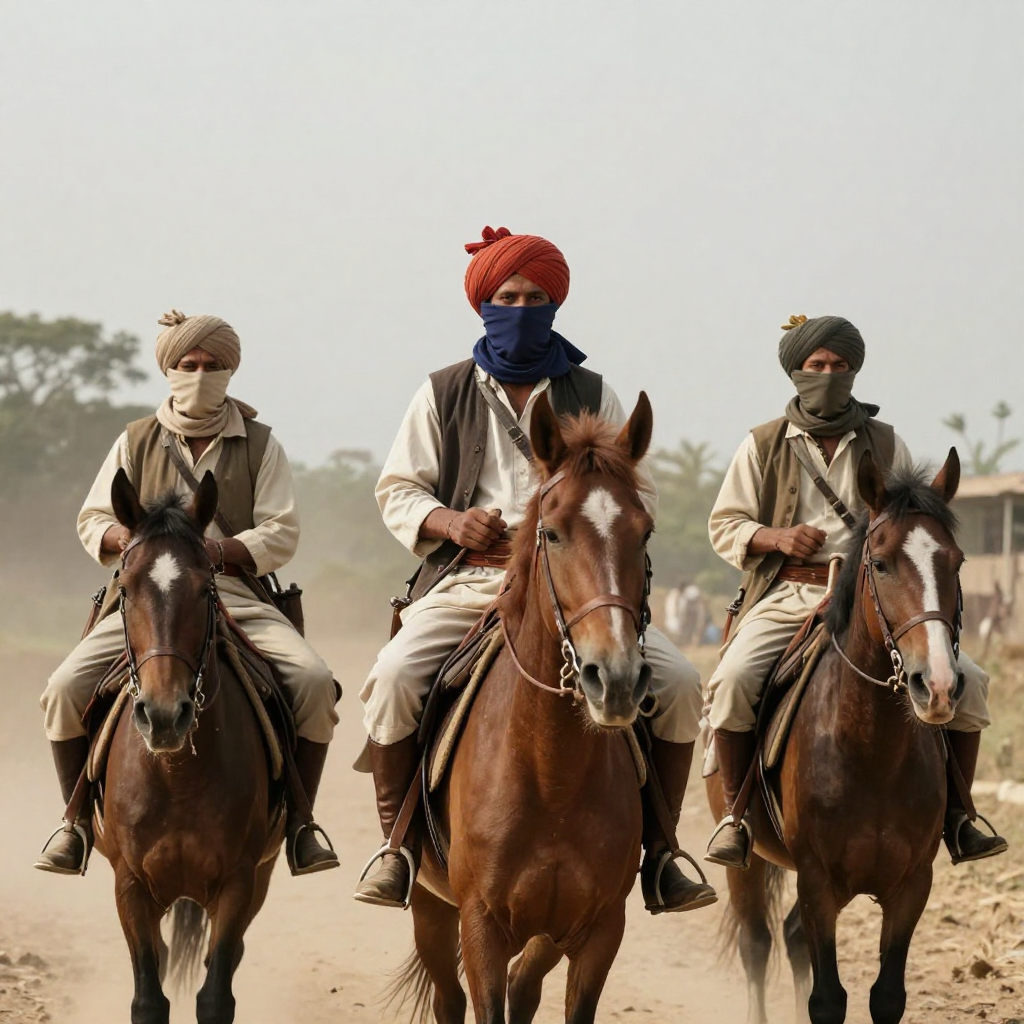
It was the early 1970s. We were a large joint-family – Baba, his four brothers, two sisters, and their families – all living around a shared courtyard. Nearly twenty children and just as many adults, turned our home into a little world of its own – noisy, crowded, and full of life. I was in high school then.
While men in the family held different jobs, we also owned a large ancestral farm. The incident happened just after the harvest. Most of the grain was sold, and the rest was stored in a big morai, a straw-rope granary placed at the center of the courtyard.
The money was still in the house. Jethu (my eldest uncle) and Baba planned to deposit it at the bank. The recent nationalisation had given Jethu, always the most prudent among them, a new sense of trust.
It was a Sunday, and there was spare money in the house. Naturally, lunch turned into a feast, mutton and rice laid out for everyone. The entire family ate together. No one complained about portions. We were simply glad to be together, finding pleasure in a shared meal.
After lunch, Baba followed Jethu into his baithakkhana — the living room. A modest wooden writing desk stood in the middle of a large godi — a cotton mattress. Baba shut the door. They didn’t want to be disturbed. I assumed they were discussing their trip to the bank the next day. Meanwhile, we had our own plans.
Every Sunday at 2 pm, the radio aired recorded dramas or jatras, popular folk-theatre of Bengal. I never missed them. They transported me into a world of fantasy, thrill and adventure.
It was choto kaku or as we lovingly called him chotka — our youngest uncle brimming with creative flair — who had fought hard to buy a radio. The ‘Murphy’ radio became his prized possession. We were mesmerized watching him tune it with precise turns of the knobs, ear close to the speaker, as if performing a sacred ritual. Needless to say, none of us were allowed anywhere near it. His wife, choto kaki, stitched a cover and even crocheted a lace runner for the top — treating the radio like royalty.
That day too, he carefully removed the covers and placed the set on a table in the porch, just outside his living quarters. After a few precise adjustments, the tuning settled — and a moment later, noted elocutionist Partha Ghosh’s deep, resonant voice filled the air.
My cousins and I huddled close. Then the announcement came — Partha Ghosh’s voice, rich and commanding:
“Today, we bring you a thrilling jatra based on the life of Devi Chaudhurani, the bandit queen of Bengal. Drawn from Devi Chaudhurani by Bankim Chandra Chatterjee, it is the story of a bold, courageous, and benevolent woman who even outwitted the British.”
“That would be one thrilling tale didi,” shouted my cousin sister Mouni.
Chotka shushed us sharply, as the opening music started to drift from the radio speakers.
In my mind, the drums, khole, behala, and pakhawaj rose together, loud and insistent. I could already see her — a woman bandit disguised as a man, sword in hand, riding a horse, shouting “Jai Bhavani” as she charged toward a rich man’s entourage.
But instead, came the soft shehnai, carrying the strains of a wedding.
Devi Chaudhurani, before she became a dacoit, was called Prafulla. She was married to the rich and greedy zamindar, Haraballabh’s only son Braja. A misunderstanding led Haraballabh to abandon her, leaving Prafulla in poverty, burdened with the care of her ailing widowed mother.
As I listened, I got lost in their grief. The sorrow of two women, trapped by the diktats of the patriarchal society, brought tears to my eyes. Prafulla’s pain felt strangely personal. Why men get to decide a woman’s fate? How easily they could abandon her. Would a woman ever have a voice of her own — a life she could truly call hers?
Prafulla begged her in-laws for shelter. Haraballabh refused. He even mocked her — told her to steal if she had to survive.
Broken and cast adrift, by a twist of fate, Prafulla met Bhavani Pathak, the famed dacoit leader of the Sanyasi Movement. Under his tutelage, she was reborn as Devi Chaudhurani — striking fear into the wealthy samaj as she led daring raids by boat.
As the jatra moved into one such raid, I closed my eyes, letting the scene unfold in my mind. The cries of “Jai Bhavani” rose again and again.
Then the chanting felt too real.
Confused, I opened my eyes. Everything seemed to move in slow motion.
Gunshots rang through the air, colliding with the cries of “Jai Bhavani,” while voices erupted all around the house — “Dacat poreche!” Dacoits were raiding the house.
Mouni dragged me away from the porch. We barely made it into chotka’s room, locking ourselves in with choto kaki, before the dacoits burst into the courtyard on horseback.
We peered through the cracks of the door. Five men stood there, dressed in black kurtas and dhotis, their faces half-hidden by the trailing ends of their pagris. Only their eyes were visible — blazing, rimmed with black kajal — and the dark tilaks stamped across their foreheads.
It felt as though the zamindar’s nightmare had come alive — as if Devi Chaudhurani’s aides had leapt from on air, straight into our house.
A burly man with a menacing voice and bloodshot eyes barked, “Who is Deviprasad Das?”
I guessed that must be the sardar, the leader of the gang.
Deviprasad — my jethu — stepped forward, broad-shouldered and steady.
Not afraid of challenges, he said in a calm and clear voice, “I am Deviprasad Das.”
How could Jethu remain so calm in a moment like this? My teenage mind couldn’t comprehend it.
I wanted to scream at him to run. But he didn’t move. He stood his ground.
In that instant, I understood what it meant to be the head of a family — not a title to be feared or obeyed, but a responsibility carried quietly. Jethu was standing there for all of us, ready to fight if he had to.
The sardar snarled, “You think you’re clever, don’t you? I know all your tricks. Look around — you’re outnumbered, and we’re armed. You wouldn’t want the women or the children hurt. So bring the money from your office. Now.”
The other dacoits had already herded the men together, including four of my older cousins. Women and children had bolted themselves into rooms. For the moment, we were hidden. Safe — for now.
But I knew enough stories to understand how little that meant. Dacoits didn’t show mercy. Money didn’t guarantee safety.
Cries rose through the house — women wailing, metal clanging, anything to make noise.
“Keep quiet or else I will kill your men,” the sardar barked.
He pointed his gun at my eldest cousin. “Get the money.”
We screamed in unison, while Jethu calmly said, “There is no money at home.”
Taken by surprise, the sardar thundered as he advanced on Jethu. “What do you mean? I know you got the money yesterday. Today is Sunday — you haven’t been to the bank. Don’t lie to me. This is your trickery.”
“There is no trickery,” Jethu said, unshaken. “I’m telling you the truth. Your informant gave you wrong information.”
A thought struck me like lightning. Of course — there had to be an informant. Jethu must have realised it too.
“Stop lying! You were going to the bank tomorrow. The money has to be here!” the sardar snarled.
“As I said, someone misinformed you,” Jethu replied evenly. “And yes — there was a bit of trickery on my part too. If you want to know what happened, lower your weapon first.”
“Lower my weapon? How dare you!”
The sardar roared and brought the heavy wooden butt of his gun down on Jethu’s leg.
Jethu screamed but stayed on his feet. He knew he couldn’t falter now.
“Tell me the truth,” the sardar demanded, grinding the gun barrel into the open wound on Jethu’s leg.
Anyone else would have collapsed by now. Jethu didn’t. He was made of a different mettle. He had lost his father at thirteen and stepped into a man’s place before he had finished being a boy. He gave up his own education so his brothers could study, got his sisters married, and held the family together year after year. Pain had never been allowed to stop him. This was just another test.
Through the agony, he said steadily, “I’m telling you again — you were misinformed. We got the money on Friday. I deposited it the same day. I never brought it home. The rest was a ruse, to draw out anyone who tried to steal it.”
“Liar!” the sardar shouted, but his voice wavered.
He turned sharply to one of his men. “Go. Fetch the wooden desk, Dina. I know he keeps the money there.”
Panic gripped me. Now we’re done for. If they found the money, we would all be slaughtered.
Dina dragged the desk outside and forced it open with the key taken from Jethu’s kurta pocket.
They tipped it over. Papers, a few small notes, and loose change spilled onto the floor. The thousands they had come for were nowhere in sight.
“Search the house! Grab whatever you can. Snatch the jewellery!” the sardar barked, now clearly agitated.
Dina leaned in and whispered, “But sardar, Nandu said they keep their jewellery in the bank. We can take what the women and children are wearing, but that won’t be enough.”
“I don’t care. I have never been humiliated like this before. I’ll kill this man,” sardar hissed, pressing the gun to Jethu’s chest.
We screamed.
The sardar shouted “Jai Bhavani!” and pulled the trigger, but the gun jammed.
It wasn’t his day. Ma Bhavani clearly stood with the man willing to give his life for his family.
Before anyone could move, shouts rang out from outside. “Make way for the police van!”
A lookout burst in, breathless. “Sardar, the police are almost here. We need to run. Now.”
“You got lucky today, Deviprasad,” the sardar snarled as he fled on horseback. “Don’t worry — I’ll be back.”
Dina paused to snatch chotka’s prized Murphy from the porch. As chotka wailed, Dina hurled a couple of crude country grenades to cover their escape, and the gang disappeared into the fields.
Just then, the police arrived, accompanied by Jethu’s youngest son.
The entire household erupted in chaos.
Jethu raised his voice. “Everyone, remain silent. Go back to your rooms. I need to speak to Inspector sahib in private.”
No one dared disobey. Whispers rose and fell. Only chotka’s sobs broke the silence.
After what felt like an eternity, Jethu, Baba, and Inspector sahib finally emerged from the baithakkhana.
“Since nothing has been stolen, we can register a case of attempted robbery,” the Inspector said.
Chotka sprang up and rushed toward him. “What do you mean nothing was stolen? What about my Murphy — my beloved Murphy? I want to lodge a formal complaint. Please arrest the culprits and get it back.”
“The radio?” asked the inspector, puzzled.
“It’s not just a radio,” Chotka said through tears. “It’s my Murphy.”
“I’m not sure we can do anything about that,” the Inspector replied, already turning away. “But I’m sure you can buy a new one.”
Too stunned to respond, Chotka broke down. Jethu slipped an arm around him.
“Don’t worry, choto,” he said quietly. “I’ll get you a new one.”
Chotka hugged Jethu tightly as if he had just been promised his entire share of the family property!
A doctor was called. Jethu’s injuries, thankfully, were not serious. The police caught Nandu, the informant, and before long, the gang was behind bars.
Life returned to normal.
Yet one question kept buzzing in my head – What had really happened to the money?
Weeks later, as chotka tuned his new radio, I finally gathered the courage to ask. Jethu was lounging in his chair, a newspaper spread open before him.
“Jethu,” I asked, “Why didn’t the dacoits find any money in your desk? Was it really not there that day?”
He peeked over the paper and simply gave me a mischievous smile.
That was when I knew — Jethu was the ultimate trickster.
——
The story came to an end, but the glint in Ma’s eyes remained.
Ma glanced back at her phone, smiling slyly — and it struck me then.
Trickery runs in her blood.
Image: AI-generated